
Driving Innovation: Empowering the Automotive Future Through IoT Training and Infrastructure
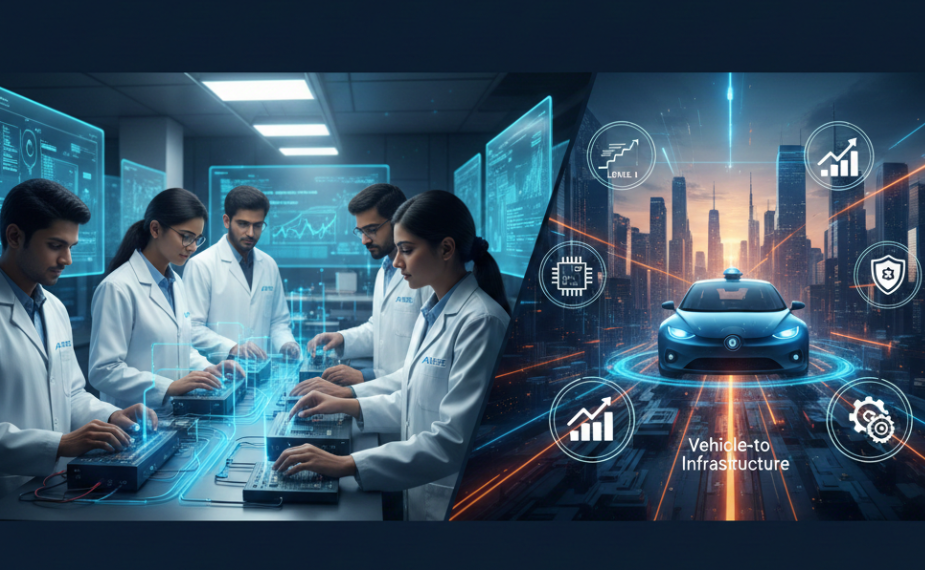
The intersection of the physical and digital worlds is no longer a concept for the future; it is the current reality of the industrial landscape. The advent of Internet-of-Things (IoT), inter-device communications, and sensor networks has revolutionized how we interact with machines. In the automotive sector specifically, IoT is "shaking up" the industry by enabling everything from driver-assist features to advanced research into driverless vehicles.
To harness this potential, IIT Madras has developed a new proposal on "Empowerment through a Training Infrastructure and Program for IoT", a comprehensive initiative aimed at building structured, hands-on IoT capabilities through advanced training programs, dedicated laboratories, and real-world solution development.
The Critical Need for IoT Skilling
Both central and state governments are actively promoting "right-skilling" to meet modern industrial demands. IoT is no longer just a technology; it is the backbone of significant solutions across various sectors.
For MSMEs (Micro, Small, and Medium Enterprises), building strong internal competence in IoT is vital. It allows these organizations to:
A CSR Collaboration with Purpose
At its heart, this initiative is a powerful example of how CSR and academia can come together to make a tangible impact. Vertiv, known globally for its expertise in powering and protecting digital infrastructure, is extending its commitment to India by supporting STEM education and digital skills development through this collaboration with IIT Madras.
The goal? To nurture the next generation of professionals capable of managing the data centers that keep our digital world running.
Empowering 2,000+ STEM Students Nationwide
Under the program, over 2,000 students from science, technology, engineering, and mathematics (STEM) backgrounds will undergo a 35-hour self-paced online course on Data Center Operations and Maintenance (O&M).
But that's just the beginning. From this pool, a select 160 outstanding students will be invited to the IIT Madras campus for afive-day immersive training program. Here, they'll gain first-hand experience in data center technologies, from power and thermal management systems to remote monitoring and predictive maintenance.
On completion, participants will earn the Certified Intelligent Data Centre - Operations & Maintenance (CIDC-O&M) certification from IIT Madras, a highly regarded credential in the world of AI-driven, data-powered infrastructure management.
Bridging the Gap Between Education and Employability
India's digital economy is booming, but so is the demand for skilled professionals who can keep it running seamlessly. This is where the IIT Madras-Vertiv collaboration steps in.
By combining academic excellence with industry expertise, the program ensures that students gain not just theoretical understanding but alsopractical, hands-on skills that make them immediately employable in real-world data center operations.
Every module is designed to align with the evolving needs of India's critical digital infrastructure, ensuring participants are job-ready the moment they step into the industry.
- Improve productivity by an estimated 25-30% through just-in-time planned servicing.
- Reduce machinery breakdowns by approximately 70%.
- Enhance the quality control and serviceability of equipment.
A Staged Approach to IoT Mastery
The IIT Madras proposed program is structured into two distinct levels to ensure a comprehensive learning curve:
- Level 1: Basic IoT Introduction. This 4-5 day workshop introduces students to IoT architecture and its core components. Participants gain hands-on experience and receive an IoT kit to implement simple solutions at their own workplaces.
- Level 2: Advanced IoT Specialization Moving deeper into technical domains, Level 2 covers Embedded Systems, Communication in IoT, Sensor devices, and Edge-computers. This level focuses on defining complex problems and creating customized solutions.
State-of-the-Art Lab Infrastructure
Skilling requires more than just a classroom; it requires dedicated space for experimentation. The project involves building a sophisticated lab infrastructure featuring:
- Modular Plug-and-Play Platforms: Users can test specific modules by fitting them into a complete IoT ecosystem to evaluate their impact before full-scale implementation.
- Simulation Environments: The lab will simulate real-world changes to be sensed by devices, allowing for the testing of new algorithms and features.
- High-End Computing: Servers and edge-computing devices will be available for advanced data analytics.
Societal and Economic Impact
Beyond industrial efficiency, IoT serves a profound social purpose. By developing Driver-Assist solutions, the automotive sector can provide real-time warnings to drivers, enforce road rules (such as mandatory helmet use), and ultimately reduce irreparable losses caused by accidents. From an economic standpoint, the benefits are clear. For example, simple IoT-enabled maintenance like monitoring tire pressure can increase tire life by 25-30% and reduce fuel consumption by up to 8%. Properly maintained vehicles can see their operational life extended by 2 to 4 times.